Anchored Model Layering
Part 2 of 4 in the Long Thinking series
The time, energy, and focus required to develop a good idea are often overlooked because “having an idea” is conflated with the euphoric moment of first glimpsing what the idea might be. This eureka moment rarely means that you have the idea. Instead, it means you were given a direction to work in to earn the idea.
The work required to fully grasp an idea rarely gets done in a single session. Sometimes, you have to push yourself for days, weeks, or even months to get the idea. The Zettelkasten provides the perfect platform for this type of prolonged work.
But there are tools that you can use to bridge the gap between the platform and the idea. One of these tools is anchored model layering.

A model is a structure that relates entities to each other and provides part-to-part relationships and part-to-whole relationships, often to map a part of reality or a fictional reality.
If two or more models share entities, you can use these shared entities to create a basic meta-model structure that relates all of these models to each other. This entity is our anchor.
The following meta-model brings together all endurance intensity models I’ve learned and expect to learn. On the left side, the fiber spectrum provides an anchor and functions as the y-axis. It starts with small green fibers and ends with big red ones. The spectrum serves as the ascending intensity scale. Instead of using an abstract scale, I grounded this meta-model in real physiology.
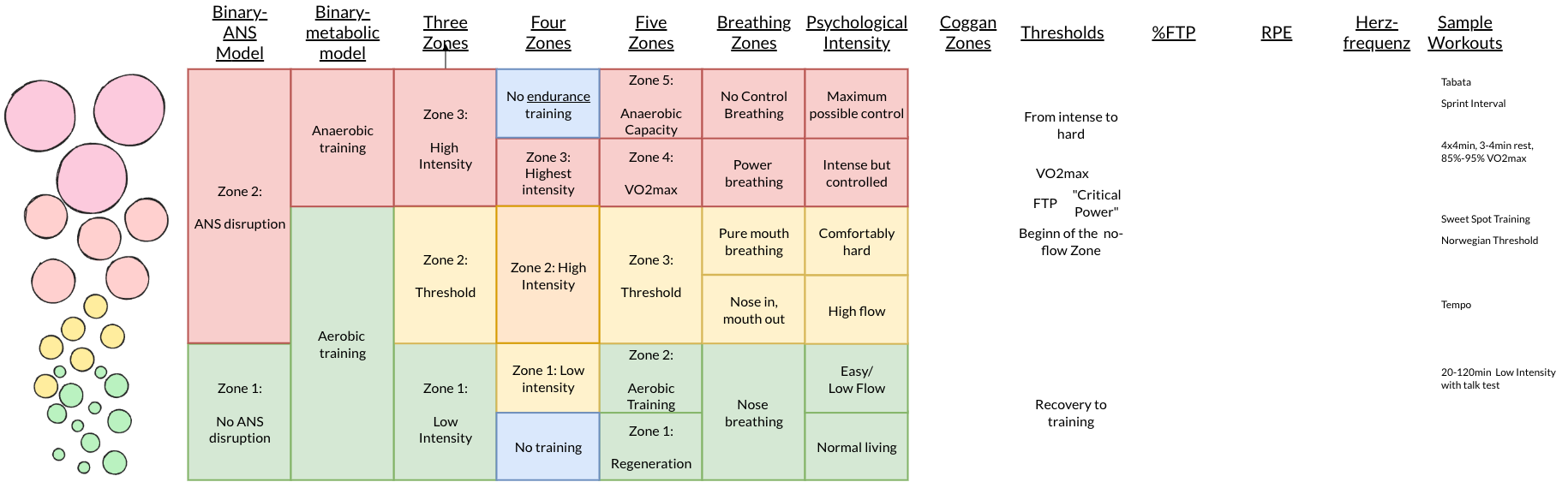
With this framework, I can integrate everything I learn about intensity in endurance training into one framework. To me, this is extremely valuable because I am working on a first-principles model for exercise intensity.
There are two entities that are universal to any endurance-intensity model. They are the two thresholds. The first threshold divides low-intensity and medium-intensity. The second threshold divides medium-intensity and severe intensity.
At the same time, raising intensity means increasing motor unit recruitment. Basically, the faster you go, the more muscle you use to sustain the activity.
The motor units provide a scale of intensity, with the two thresholds providing universal landmarks for any model. This is our first dimension and anchor.
Our second dimension is the discrete aspect of the system that can be mapped to an intensity scale.
I can integrate the work by Wod Science that focuses on functional fitness (basically circuit training) with Andy Coggan’s work on cycling. Additionally, I can create mini-models that focus on particular aspects of exercise intensity. I could, for example, add a liver-specific model that relates just the liver to the exercise intensity.
When and how to use this technique? Whenever you deal with many overlapping models, it is beneficial to create a universal framework. To build this framework, you need one necessary ingredient: a unifying aspect that provides the first, fixed dimension for the y-axis. The best-case scenario is that the y-axis is finite. That means it has a starting point and an endpoint. The x-axis can be expanded to infinity. This means that the meta-model has a partial completeness claim. After all, you can always add another model to the meta-model and should be open to it.
Once you’ve built your framework, you’re set up to supercharge long thinking. It is defined as the persistent effort to think about one problem or idea that spans multiple long thinking sessions.
The power of the technique: We often hear that we should work persistently on problems to create valuable knowledge. We seldom hear how to work persistently on such problems. Techniques like the one above solve the “how.”
The Zettelkasten Method provides the platform; the anchored model layering provides the exact tool to develop complex and integrated knowledge. Deep work describes how to design the external conditions of our thinking. Long thinking is about a specific cognitive activity during deep work. Tools like anchored model layering provide the thinking tools to facilitate cognitive technique. The Zettelkasten Method provides a specific thinking environment to exploit our efforts to build a self-improving integrated thinking environment.
If you have to long think anyway it is pragmatic to exploit this activity by creating a system of notes that can act as an integrated thinking environment.
What’s the verdict then? Complex thinking is a craft. Like any craft, it can be learned, practiced, and systematically improved. Once you start treating it like a craft, persistent work on hard problems stops feeling like a heroic act of willpower and starts feeling like a system you can sit down and run.