Rambling about Sorites
Part 3 of 4 in the Long Thinking series
Hi Zettlers,
I thought I’d share another example of applying anchored model layering. If you missed the last post, read it first. Otherwise, you won’t understand this short post.
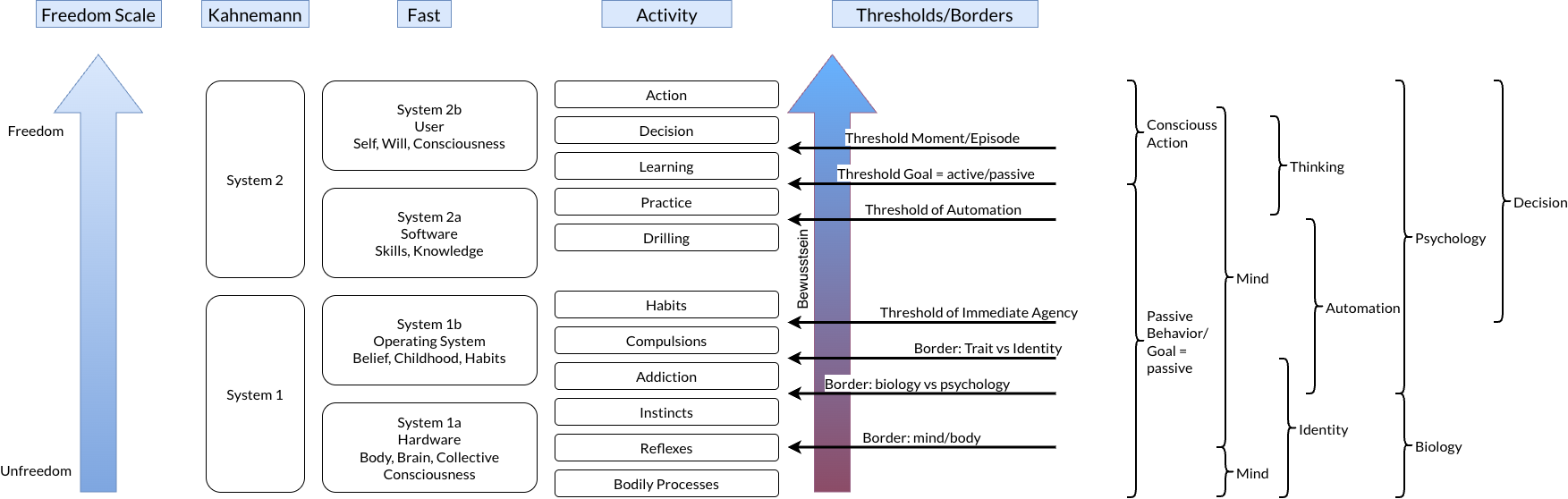
Here, two anchors are used: The freedom/unfreedom scale and the consciousness scale. This meta-model is an ongoing effort to create a map that brings together many important concepts from different disciplines.
There is a constant call for “interdisciplinary thinking”, yet often it remains a blurry and unclear call. The call for interdisciplinary thinking often remains a lofty aspiration, with little instruction on how to do it. This technique is a tool to put into practice the lessons I learned from the highly recommended book Consilience. The Unity of Knowledge by the great E.O. Wilson.
I’ll give you two practical examples of why these techniques matter.
Psychology and the theory of mind are closely related fields. Yet, from a philosophically biased perspective, engagement with heavy concepts like agency or happiness remains subpar in the vast majority of psychology papers I read. How can you do research about happiness when your understanding of the concept of happiness remains bound to the intuitive use of the words in the self-reporting of the subjects of your research? Simply put: People can be wrong about being happy and could be typically wrong about accessing their own happiness. Still, the majority of happiness research is based on self-reports, which are very unreliable—based on reliable research.
In diet research, many studies are not well controlled. Subjects are given instructions on how to eat for the duration of the study and then go on with their lives, hopefully adhering to them. This is a major criticism of the research’s reliability. One could say the research is often less about different diets than about different instructions for different diets.
However, for me as a trainer, the research method closely matches what I do. I give instructions and explanations. Then my clients go on with their lives, and I hope that we meet again and they will have followed my instructions. I don’t care whether a diet approach works in highly controlled situations. I care about the real world.
In both cases, laying down an interdisciplinary model like the one above would provide a foundation to help avoid such problems. The two examples show problems on the level of the pure craft of knowledge.

Do this in your Zettelkasten. For any profession, there are a few key frameworks. Predictive frameworks are one example. The example above and the example in the previous article concern a certain ontology.
Create a note in your Zettelkasten for each framework. Then make sure that you update this framework regularly. You can add this framework to your Feynman’s Darling List or make it a quarterly contemplation event.
If you deal with knowledge in any shape or form, this will provide you with great value. You’ll grow, for example, the ability to absorb knowledge from a greater variety of fields. Let me close this rambling article with a last example:
The Sorites paradox shows the problem of creating distinctions. Imagine piling grains of sand, one at a time. At first you have a couple of grains, but there is, theoretically, a moment when the grains become a heap. The philosophical challenge is to solve the riddle when this moment comes—if it comes. The value of engaging with the Sorites paradox is not to solve it, but to work through the problem of distinction and drawing conceptual boundaries.
To engage with the problem at all, you need tools and some knowledge of how to engage with it. I gave you, by the way, something already. If you don’t know, you may review the above paragraph.
Show the answer
I gave you an outcome to aim for. The desired outcome for engagement is not the solution, but to create an inventory of different solution pathways and their associated tools.
The Sorites problem provided me with the shape of “clear cases with unclear boundaries”. The grain-heap scale is an example of this shape. The problem of dealing with this shape is widespread. Examples are:
- Philosophical: Is there freedom of will?
- Training science: What is low-intensity training?
- Psychology: How to thrive?
- Religion: Am I a good person?
- Postmodern deconstructionism: What is gender?
And, as stated above, many problems around these questions could’ve been avoided if the craft of knowledge had been taken seriously.
Thank you for making it this far. And have a very nice day.
Live long and prosper
Sascha